
Introduction: The Silent Addiction Growing Inside Every Home Most parents today are not worried when their child spends hours on a mobile phone or tablet. In fact, many see it

Introduction: The Real Problem with How Our Children Learn Today
Most Indian parents believe that if a child is not writing in a notebook or memorizing answers, they are not learning. This belief has been passed down for generations, but today it is being challenged at a national level. With the introduction of NEP 2020, the education system is shifting from memorization to understanding, from pressure to curiosity, and from marks to real skills.
This change may feel confusing at first because it looks very different from traditional schooling. A child playing with objects, solving puzzles, or listening to stories may not look like “serious education.” However, this is exactly how the brain is designed to learn in early years. NEP 2020 recognizes this scientific reality and restructures learning accordingly.
What This Means Immediately:
- Learning is no longer limited to books
- Play is now a structured educational tool
- Early education is focused on brain development, not exams
- Parents must shift their definition of “study”
- Skills are becoming more important than marks
What is Play-Based Learning and Why It Actually Works
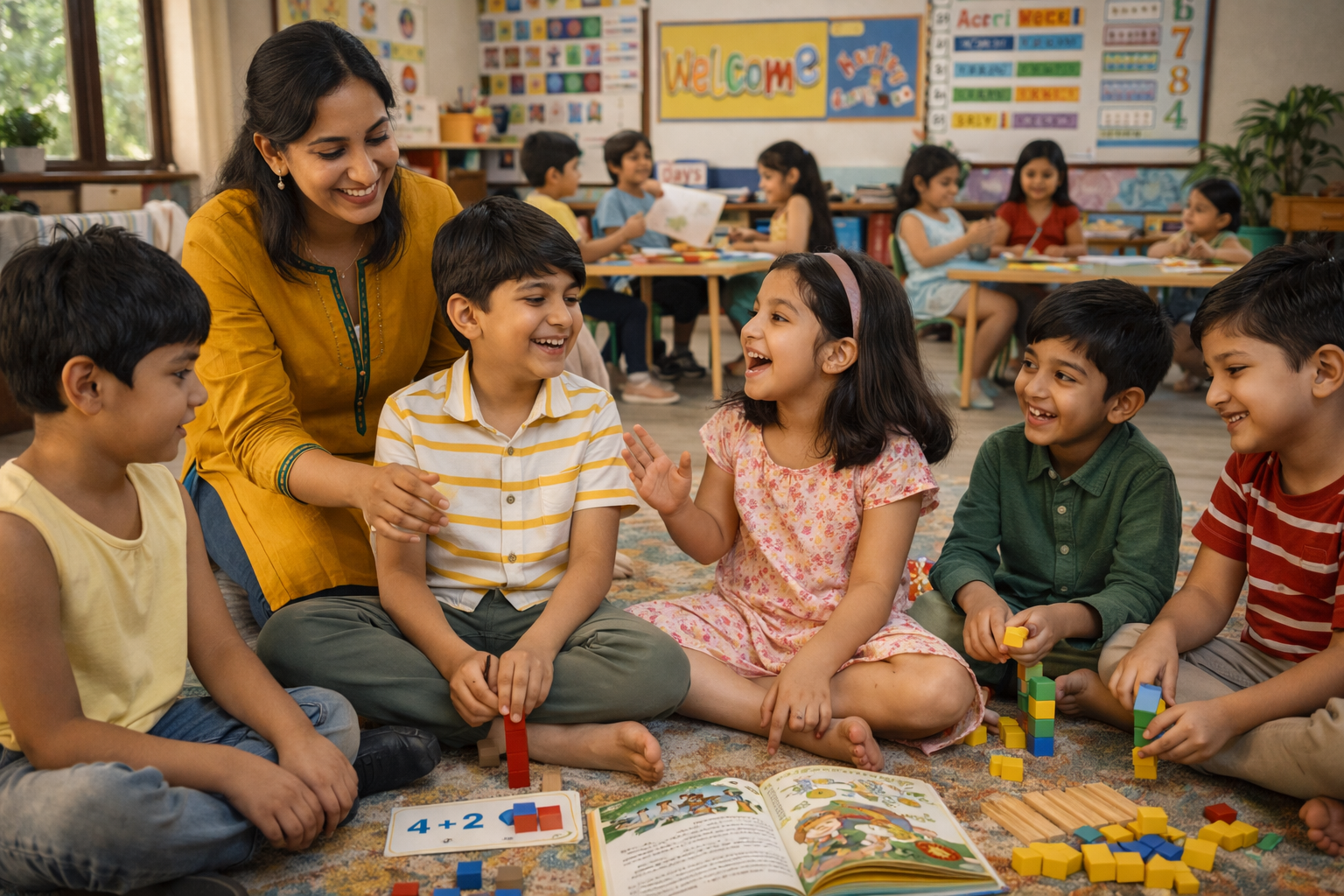
Play-based learning is a structured approach where children learn concepts through activities instead of direct instruction. It is not random play; it is carefully designed to develop thinking, coordination, and understanding. When children interact with objects, solve problems, and explore situations, they engage multiple areas of the brain simultaneously.
This method works because children naturally learn through curiosity. When they touch, build, arrange, and experiment, they form deeper neural connections. Compared to passive learning like listening or memorizing, this approach ensures better retention and application.
Practical Examples:
- Counting using real objects instead of memorizing numbers
- Learning language through storytelling and role-play
- Developing logic through puzzles and pattern games
- Understanding shapes through hands-on construction
- Improving focus through structured activity kits
Why NEP 2020 is Replacing Rote Learning
For decades, the Indian education system has been exam-driven. Students were trained to remember information rather than understand it. While this approach may produce marks, it fails to build real intelligence. NEP 2020 identifies this gap and shifts the focus toward conceptual clarity and skill development.
The modern world requires individuals who can think, adapt, and solve problems. Memorization does not prepare children for real-life challenges. This is why the policy emphasizes experiential learning from the earliest stage.
Limitations of Rote Learning:
- Encourages surface-level understanding
- Reduces curiosity and questioning ability
- Creates academic pressure without real learning
- Fails to build problem-solving skills
- Disconnects education from real life
The Foundational Stage (3–8 Years): Where Everything is Decided
NEP 2020 introduces a major structural change by identifying ages 3–8 as the most critical learning phase. During this time, a child’s brain develops rapidly, forming the foundation for all future learning. If this stage is handled correctly, children become naturally confident learners. If not, they may struggle despite years of schooling.
Instead of formal teaching, the policy promotes activity-based learning during this period. This ensures that children develop essential skills without feeling pressure or fear.
Focus Areas in This Stage:
- Language development through interaction
- Basic numeracy through real-life situations
- Emotional and social development
- Physical coordination and motor skills
- Curiosity and imagination building
How Play-Based Learning Builds Real Intelligence
True intelligence is not about remembering answers but about understanding situations and responding effectively. Play-based learning builds this ability because it forces children to think, decide, and adapt. Every activity becomes a learning experience where the child is actively involved.
When children solve puzzles, build structures, or engage in guided play, they develop logic, patience, and creativity. These are the exact skills required in higher education and professional life.
Skills Developed:
- Logical reasoning and pattern recognition
- Decision-making and independent thinking
- Creativity and innovation
- Emotional balance and patience
- Communication and teamwork
The Gap Between Schools and Home Learning
While NEP 2020 provides a clear direction, its implementation across schools will take time. Some schools are adapting quickly, while others are still following traditional methods. This creates a gap where children may not fully benefit from the new system unless supported at home.
Parents cannot depend entirely on schools during this transition phase. The home environment must also align with play-based learning principles. This is where the right tools and approach become essential.
Current Challenges:
- Uneven implementation across schools
- Lack of awareness among parents
- Continued focus on marks in some institutions
- Limited availability of structured learning activities at home
- Over-reliance on screens as a substitute
Why Most Toys and Apps Fail to Deliver Real Learning
Many parents try to support their child’s development by buying toys or downloading educational apps. However, most of these options are either purely for entertainment or overly dependent on screens. They do not provide structured learning that builds real skills.
Unstructured toys may keep children busy but do not guarantee cognitive development. On the other hand, screen-based learning often reduces attention span and limits physical interaction. This creates a need for tools that combine engagement with structured skill-building.
Common Issues:
- Toys lack learning progression
- Apps promote passive consumption
- No measurable skill development
- Short attention span development
- Limited real-world interaction
The Role of Structured Hands-On Learning Tools
To truly implement play-based learning, children need structured tools that are designed with a clear learning outcome. These tools bridge the gap between play and education by combining engagement with skill development. They are not random toys but systems that guide children through progressive learning experiences.
Such tools align perfectly with NEP 2020 because they focus on experiential learning. They help children understand concepts rather than memorize them, making learning both effective and enjoyable.
What Effective Learning Tools Do:
- Convert abstract concepts into real experiences
- Build multiple skills simultaneously
- Encourage independent exploration
- Reduce dependency on screens
- Provide measurable learning outcomes
Screen-Based Learning vs Real Play: A Critical Difference
In today’s environment, screens have become a default solution for keeping children engaged. While digital tools have their place, excessive screen exposure in early years can negatively impact attention span, eyesight, and social behavior.
Play-based learning offers a more balanced approach by involving physical activity, real-world interaction, and emotional engagement. It ensures that children develop holistically rather than becoming dependent on digital stimulation.
Key Differences:
- Passive vs active learning
- Virtual interaction vs real-world experience
- Short-term engagement vs long-term skill building
- Isolation vs social development
- Distraction vs focus improvement
What Smart Parents Are Doing Differently Now
Parents who understand the direction of NEP 2020 are not waiting for schools to fully adapt. They are proactively creating a learning environment at home that supports curiosity, exploration, and skill development. They are moving away from forcing study hours and focusing instead on meaningful engagement.
This approach does not mean removing discipline. It means redefining learning in a way that aligns with how children naturally grow.
Practical Actions:
- Introduce structured activity-based learning at home
- Replace screen time with hands-on engagement
- Encourage questioning and exploration
- Focus on understanding rather than marks
- Choose tools that build skills, not just entertain
Frequently Asked Questions About NEP 2020 and Play-Based Learning
Is play-based learning really effective for studies?
Yes, it improves understanding and retention because children learn by doing rather than memorizing.
Will children fall behind if they don’t focus on books early?
No, children who develop strong foundational skills actually perform better in later academic stages.
Can this be implemented at home?
Yes, with the right structured tools and activities, parents can easily support this approach.
Is screen learning enough?
No, excessive screen learning can limit development. Physical interaction is essential in early years.
How do I know if my child is actually learning?
If your child can apply concepts, solve problems, and explain ideas, real learning is happening.
Conclusion: The Right Time to Act is Now
NEP 2020 is not just a policy change; it is a shift in how we understand education itself. It clearly indicates that the future belongs to children who can think, adapt, and solve problems—not just memorize answers. Play-based learning is the foundation of this transformation.
For parents, the decision is simple but important. Either continue with outdated methods and hope for results, or align early with a system that is designed for real development. The sooner this transition happens, the stronger the child’s foundation will be.
What You Should Do Next:
- Re-evaluate your child’s current learning approach
- Introduce structured play-based learning at home
- Reduce passive screen exposure
- Focus on skill development over marks
- Choose tools that align with NEP 2020 principles