
Introduction: The Silent Addiction Growing Inside Every Home Most parents today are not worried when their child spends hours on a mobile phone or tablet. In fact, many see it

Introduction: Are Screens Replacing Real Learning?
In today’s digital-first world, many parents believe that educational apps are the smartest way to help their children learn. Bright colors, interactive animations, and gamified lessons create an illusion of effective learning. However, beneath this convenience lies a critical question: are children truly understanding concepts, or are they just reacting to screens?
The early years of a child’s life are not designed for passive consumption. The brain develops through sensory experiences—touching, feeling, moving, and interacting with the physical world. When these experiences are replaced by flat screens, an essential part of learning is lost. This is where tactile learning becomes not just important, but necessary.
What This Blog Will Help You Understand:
- Why touch is critical for brain development
- The difference between tactile learning and screen-based learning
- The hidden limitations of educational apps
- How real learning actually happens in early childhood
- What parents should do differently
What is Tactile Learning and Why It is Fundamental
Tactile learning refers to learning through physical interaction with objects. It involves using hands to explore, manipulate, and understand the environment. This form of learning is deeply connected to how the human brain naturally develops, especially in early childhood.
When children touch and interact with objects, they activate multiple senses simultaneously. This multi-sensory engagement strengthens neural connections and improves memory retention. Unlike passive learning, tactile experiences require active participation, making learning more meaningful and long-lasting.
Examples of Tactile Learning:
- Building shapes using blocks
- Sorting objects based on size or color
- Solving physical puzzles
- Writing and drawing by hand
- Engaging in hands-on activity kits
The Science Behind Touch: How the Brain Learns Better
Scientific research consistently shows that the brain learns more effectively when multiple senses are involved. The sense of touch plays a crucial role in this process because it connects physical action with cognitive understanding. When a child manipulates an object, the brain processes both the action and the concept together.
This process creates stronger neural pathways compared to screen-based learning, where interaction is limited to tapping or swiping. Touch-based learning also improves fine motor skills, coordination, and spatial awareness, all of which are essential for overall development.
What Happens in the Brain:
- Activation of multiple sensory pathways
- Stronger memory encoding
- Better concept retention
- Improved hand-eye coordination
- Enhanced problem-solving ability
The Illusion of Learning in Educational Apps
Educational apps are designed to keep children engaged, but engagement does not always equal learning. Many apps rely on rewards, animations, and instant feedback to hold attention. While this creates excitement, it often leads to shallow understanding.
Children may quickly learn how to navigate the app, but this does not mean they have understood the underlying concept. The learning becomes reaction-based rather than thinking-based. Over time, this can reduce attention span and limit deep learning.
Hidden Limitations of Apps:
- Passive interaction through tapping and swiping
- Overstimulation leading to reduced focus
- Dependency on instant rewards
- Limited real-world application
- Lack of physical skill development
Tactile Learning vs Educational Apps: A Critical Comparison
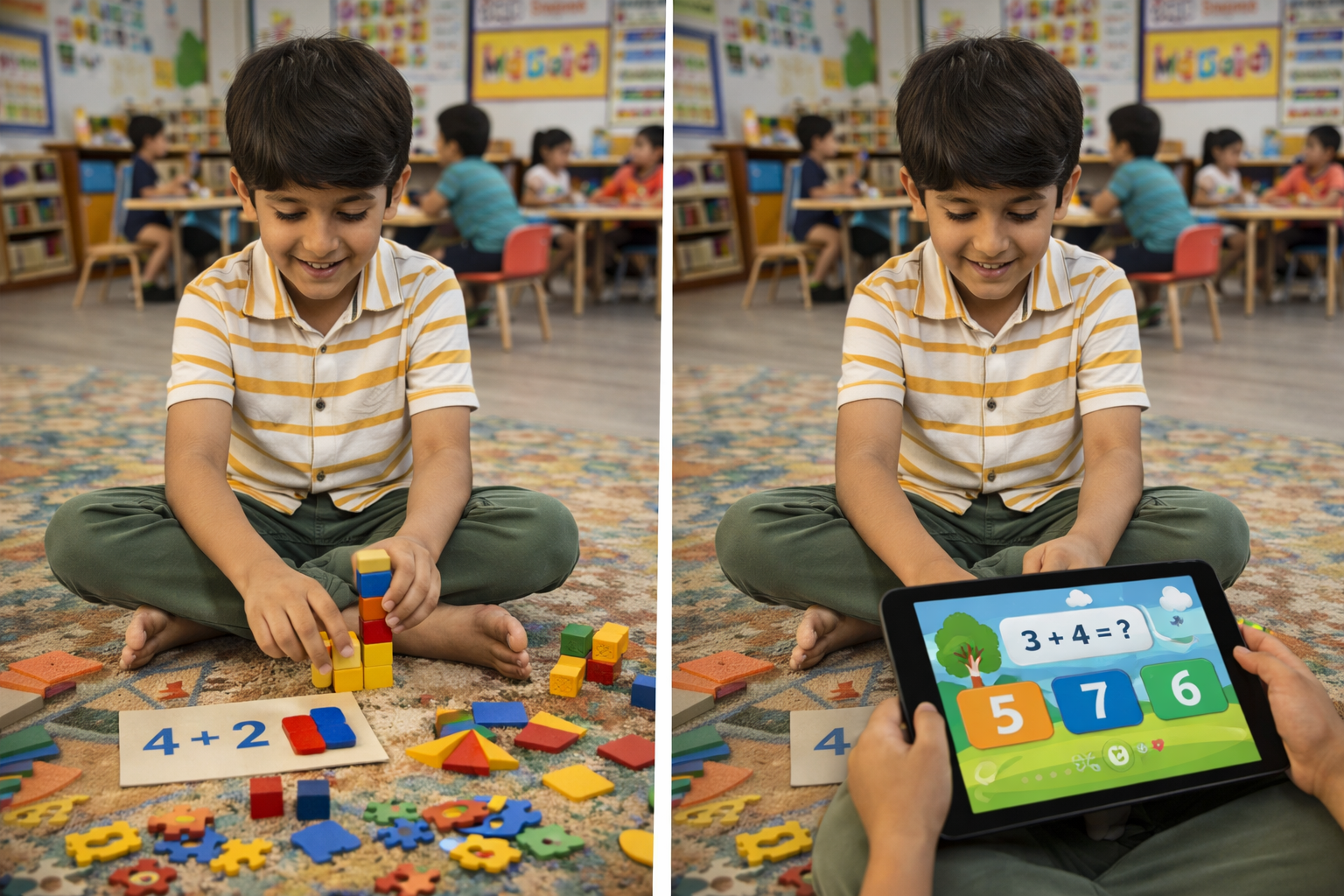
When comparing tactile learning with educational apps, the difference is not just in method but in outcome. One builds deep understanding and skills, while the other often focuses on engagement and speed. For young children, this difference becomes even more significant.
Tactile learning encourages exploration and patience, while apps often promote quick responses and instant gratification. Over time, these patterns shape how children approach learning itself.
Key Differences:
- Active learning vs passive interaction
- Real-world experience vs virtual simulation
- Deep understanding vs surface-level engagement
- Skill development vs content consumption
- Long-term retention vs short-term recall
Why Touch-Based Learning Aligns with NEP 2020
The National Education Policy 2020 emphasizes experiential and play-based learning, especially in the foundational years. This approach is closely aligned with tactile learning, as both focus on hands-on experiences and concept-based understanding.
The policy recognizes that children learn best when they are actively involved in the process. Instead of memorizing information, they should explore and discover. Tactile learning naturally supports this vision by making learning interactive and meaningful.
Alignment with NEP 2020:
- Focus on experiential learning
- Emphasis on skill development
- Reduction of rote memorization
- Encouragement of curiosity and exploration
- Integration of play into education
The Long-Term Impact of Touch vs Screen Learning
The type of learning a child experiences in early years has a lasting impact on their cognitive and emotional development. Children who engage in tactile learning tend to develop better problem-solving skills, higher creativity, and stronger focus.
On the other hand, excessive reliance on screens can lead to shorter attention spans, reduced patience, and limited real-world interaction. These effects may not be immediately visible but become more apparent as the child grows.
Long-Term Outcomes:
- Better critical thinking ability
- Stronger attention span
- Improved creativity and imagination
- Higher emotional intelligence
- Greater independence in learning
Why Most Parents Are Confused (And What They Miss)
Parents today are exposed to a wide range of educational tools, from apps to toys to online platforms. This abundance of options often creates confusion about what truly works. Many assume that anything labeled “educational” is beneficial.
However, the key difference lies in how learning happens, not just what is being taught. Tools that engage children physically and mentally are far more effective than those that simply deliver content.
Common Misconceptions:
- “If it’s educational, it must be good”
- “Screens are necessary for modern learning”
- “More engagement means better learning”
- “Apps can replace physical activities”
- “Early screen exposure improves intelligence”
The Role of Structured Hands-On Learning Tools
Not all physical toys lead to meaningful learning. For tactile learning to be effective, it must be structured and purposeful. This is where well-designed hands-on learning tools play a critical role.
These tools combine engagement with clear learning objectives. They guide children through activities that build skills progressively. Unlike random play, structured tools ensure that every interaction contributes to development.
What Makes Them Effective:
- Designed with specific learning outcomes
- Encourage problem-solving and thinking
- Build multiple skills simultaneously
- Keep children engaged without screens
- Support independent learning
What Smart Parents Are Doing Differently
Parents who understand the science behind learning are making conscious choices about how their children spend time. They are not completely avoiding technology but are balancing it with real-world experiences.
They prioritize activities that involve touch, movement, and interaction. They create an environment where children can explore, experiment, and learn naturally. This approach leads to better development without unnecessary pressure.
Practical Changes:
- Reducing unnecessary screen exposure
- Introducing tactile learning activities
- Encouraging hands-on exploration
- Creating structured learning routines
- Choosing tools that build real skills
Frequently Asked Questions About Tactile Learning
Is tactile learning better than digital learning?
Yes, especially in early childhood. Tactile learning engages multiple senses, helping children understand and retain concepts better than passive screen-based learning.
Can educational apps replace hands-on learning?
No, apps can support learning but cannot replace physical interaction. Real-world experiences are essential for developing thinking, coordination, and problem-solving skills.
At what age is tactile learning most important?
Tactile learning is most critical between ages 2–8. This is when the brain develops rapidly and responds best to sensory and hands-on experiences.
How can parents implement this at home?
Parents can introduce structured hands-on activities like puzzles, building kits, and sorting games. Reducing passive screen time also helps create a better learning balance.
Does tactile learning improve academic performance?
Yes, it builds strong foundational skills like focus, logic, and understanding. These skills directly support better academic performance in later years.
Conclusion: Real Learning Happens Through Real Interaction
The future of education is not about choosing between technology and traditional methods. It is about understanding how children learn best and aligning with that process. Tactile learning is not an old-fashioned approach—it is a scientifically proven method that supports real development.
Educational apps may offer convenience, but they cannot replace the depth of learning that comes from touch and interaction. For parents, the decision is not about removing technology but about ensuring that it does not replace essential learning experiences.
What You Should Do Next:
- Evaluate your child’s current learning habits
- Reduce passive screen exposure
- Introduce structured tactile learning tools
- Focus on skill development, not just content
- Create a balanced learning environment